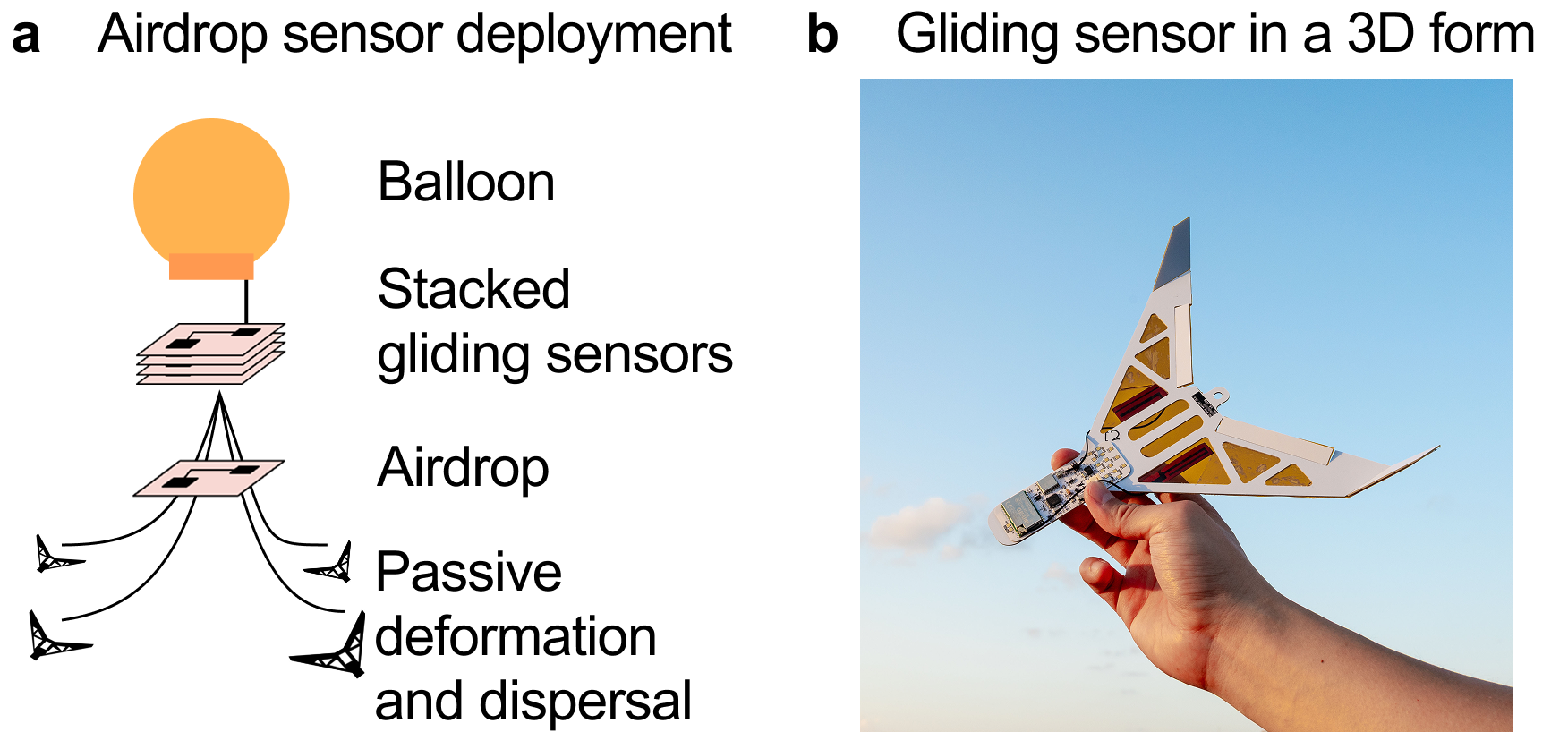
気象予測の精度向上には海上大気の直接観測が必要であり、数kmの広範囲を低コストで観測する手法が求められている。そこでドローンや軽気球等の飛翔体から小型センサを投下・散布する空中散布型センサシステムが着目されている。しかし、広範囲のデータ取得には滑空性能が高い立体的な筐体が必須となる一方で、立体構造は積載効率が低く、さらに空中でアクティブに形状を変化させる従来のアクチュエーション機構も電力消費や構造の複雑さから大規模展開の障壁となっていた。そこで積載時には平面形態で、投下後に滑空に適した立体形態に展開するためのパッシブな機構が必要である。
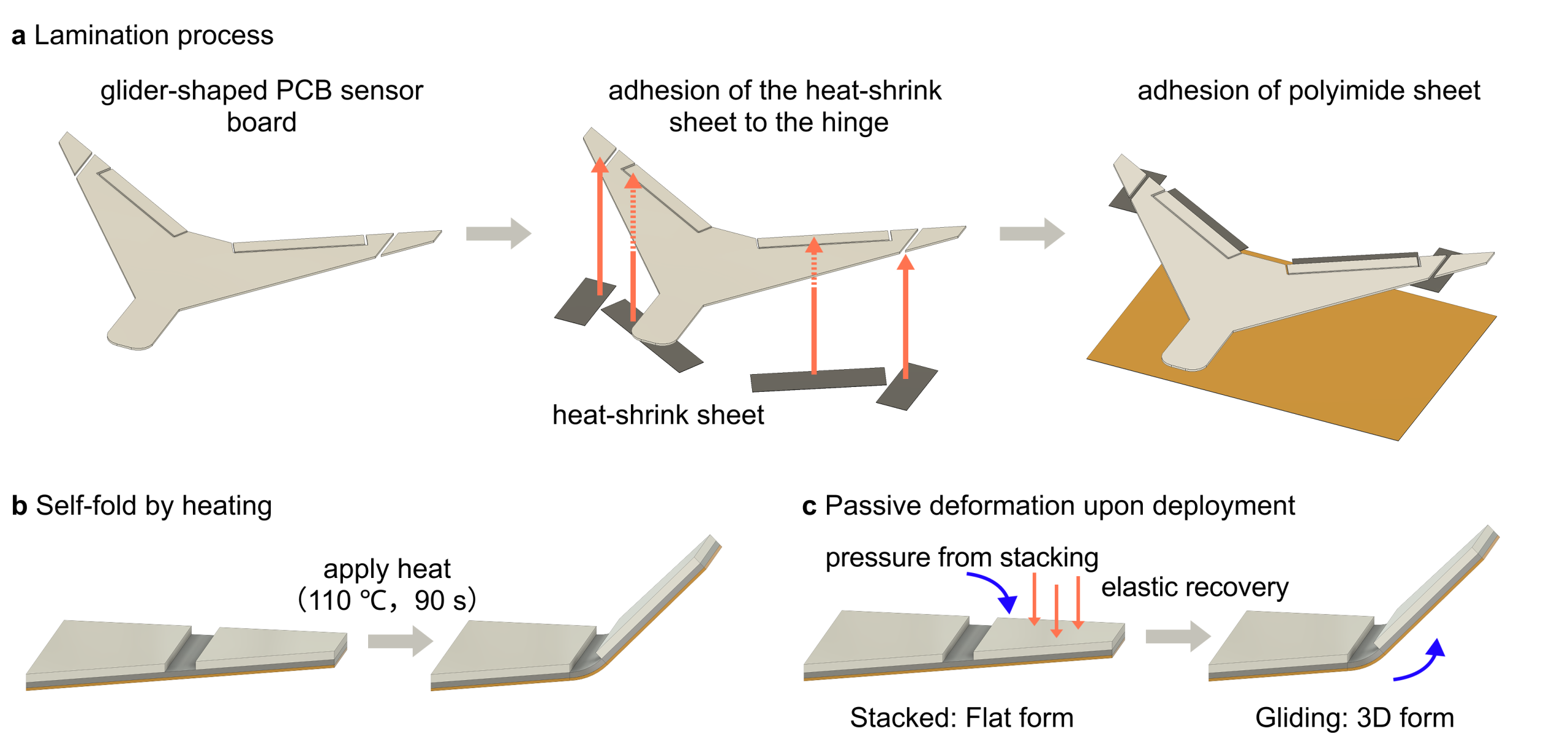
本研究では、プリント基板を構造材として用い、平面積載可能な状態から投下後に電力を要さず立体形態へ復帰するパッシブ弾性ヒンジ機構を提案する。本手法はPCBとシート材料の積層・接着および加熱という2次元プロセスのみで高精度に二面角を作成可能で、複雑な組み立て工程を要さず、電子回路機能と物理的な機体構造を完全に統合したグライダ型立体センサの製造を実現する。
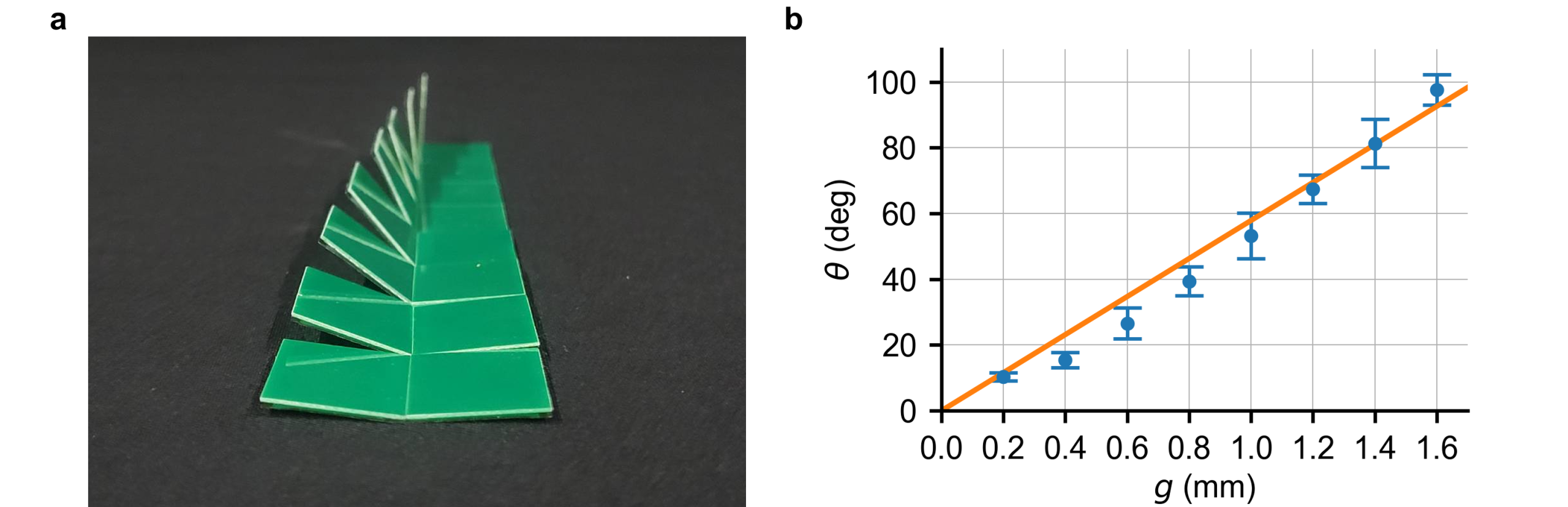
安定した折れ角を設計する幾何学モデルおよび空中展開に必要な弾性を評価するモデルを構築、検証した。さらにグライダ型センサの実機を作成し、実飛行試験での滑空・通信の成立や、シミュレーションによる広域散布の有効性を実証した。既存の基板製造プロセスを活用できる本アプローチは、大規模散布の障壁であった積載性と量産性の課題を同時に解決し、未開拓であった海上の高解像度大気観測網の実現に道を開くものである。
Improving forecasting of weather requires direct observation of the ocean atmosphere, creating a critical need for low-cost monitoring across multi-kilometer scales. Air-dispersed sensor systems deployed from aerial platforms, such as UAVs or lightweight balloons, have emerged as a promising solution. However, the three-dimensional glider shapes required for wide-area dispersion severely limit stackability. Moreover, the power consumption and structural complexity of conventional actuated mechanisms were bottlenecks for large-scale deployment. Thus, a passive mechanism that transforms from a flat, stackable form into an aerodynamic glider—without mid-flight active actuation or external power—is highly desirable.
Here, we propose a passive elastic-hinge mechanism that uses rigid printed circuit boards (PCBs) as structural materials to passively transition from a planar, stackable state to a 3D state. Fabricated with a simple two-dimensional process—laminating a rigid PCB with sheet materials followed by a single heating step—this approach reliably forms accurate dihedral angles without complex assembly. This enables the seamless integration of electronic circuits and physical airframe structures into a unified glider-type sensor.
We constructed and validated geometric and analytical models to design stable fold angles and evaluate the hinge elasticity required for aerial deployment. Furthermore, we implemented this mechanism in a glider-shaped sensor prototype, demonstrating successful gliding and wireless data communication in real-world flight tests, and confirmed the effectiveness of wide-area dispersion via simulation. Compatible with standard PCB manufacturing, our approach simultaneously overcomes the critical barriers of stackability and scalability in large-scale deployment, paving the way for previously unrealized high-resolution atmospheric monitoring networks over the ocean.
Damyon Kim, Yuichi Honjo, Tatsuya Iizuka, Naomi Okubo, Yuito Takeuchi, Naoto Endo, Hiroshi Matsubara, Yoshihiro Kawahara, Morita Naoto, Takuya Sasatani
連絡先/Contact
kim_d@akg.t.u-tokyo.ac.jp, sasatani@g.ecc.u-tokyo.ac.jp